
Military vehicles, armoured personnel carriers and other demanding defence platforms set exceptionally high requirements for their interior structures. Components must be lightweight, durable, fire-retardant and designed for long service life under the most challenging operating conditions. Composite and fibre-reinforced plastic structures meet all of these requirements — and go further.
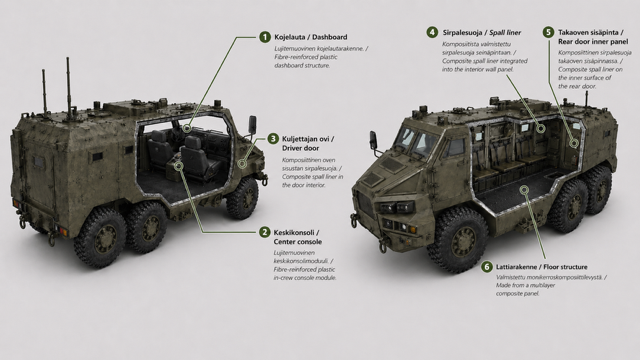
Fire-Retardant FRP for Vehicle Interior Structures
Fire-retardant fibre-reinforced plastic offers significant advantages for manufacturing vehicle interior structures. Unlike metal alternatives, FRP components can be shaped freely, integrated with additional features and pre-assembled into modular units — reducing both assembly time and long-term maintenance complexity.
Typical interior applications in military and demanding vehicles include:
Dashboards and instrument panels — fibre-reinforced plastic dashboard structures
Centre consoles — modular in-crew console modules
Control panel frames — structural frames for instrument and control integration
Spall liners — composite spall liners integrated into interior wall panels, driver doors and rear door inner panels
Floor structures — multilayer composite panels for vehicle floor construction
Key Benefits of Composite and FRP Structures
Composite and fibre-reinforced plastic structures offer a combination of properties that are difficult to achieve with traditional materials:
- Greater design freedom for ergonomic and functional layouts
- Modular structure for faster assembly and easier maintenance
- Significant weight savings while maintaining structural integrity
- Fire-retardant material options for safety-critical environments
- Safer and more ergonomic cockpit environment
- Faster installation in production and maintenance
- Long service life in demanding conditions
Integrated Features — Beyond the Structure Itself
One of the key advantages of composite structures is the ability to integrate additional functionality directly into the component. Composite vehicle interiors can incorporate sound insulation, thermal insulation, heating solutions, cabling, fastening points and other vehicle-specific functions — all built into the structure rather than added as separate layers.
This approach reduces part count, simplifies assembly and improves overall vehicle performance.
Weight Savings and Mobility
Composite and fibre-reinforced plastic solutions reduce overall vehicle weight while maintaining safety standards. For military and special vehicles, this translates directly to improved mobility, increased payload capacity and reduced energy demand — all critical factors in operational performance.
Enabling New Technologies
Composite interior structures can be designed from the outset to accommodate electrical systems, sensors, heating equipment, communication devices and other future vehicle technologies. This forward-looking approach supports the integration of new systems throughout the vehicle’s service life.
LICO’s Experience in Demanding Composite Applications
LICO has extensive experience in designing and manufacturing composite and fibre-reinforced plastic products for demanding applications. Our expertise covers military vehicles, working machines, rail equipment, marine applications, agricultural and forestry machinery and other demanding vehicle and equipment solutions.
When the goal is a lighter, stronger, safer and more efficiently manufactured vehicle structure — composites are a strong choice.
Contact Us
Interested in composite components for your marine or vehicle application? Contact LICO — we are happy to discuss your next project and find the right solution for your needs.